This article introduces the concept Creative-worldview and explores its implications for how creativity is understood across culture, education, health and community life.
Dr Carla van Laar
10 March 2026
Creative-worldview: Cultivating the Human Capacities to Sense, Relate and Create
Creative-worldview understands creativity as a fundamental human capacity through which people sense the world, relate within it, and create meaning within the larger patterns of life
Creative-worldview (noun)
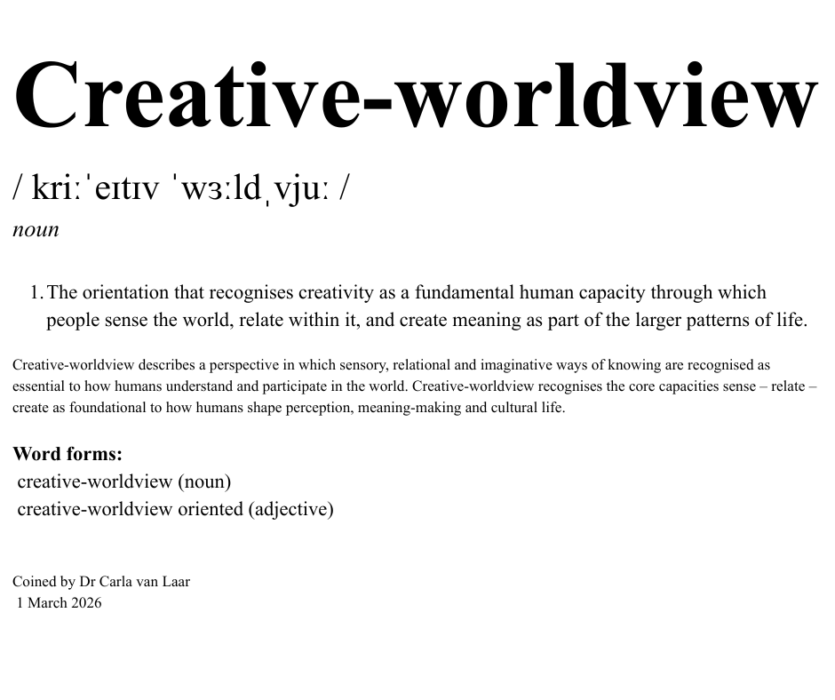
Definition: The term Creative-worldview was introduced by Dr Carla van Laar (2026) to describe an orientation that understands creativity as a fundamental human capacity through which people sense the world, relate within it, and shape meaning within the larger patterns of existence.
Creative-worldview understands creativity as a fundamental way in which humans encounter, interpret and participate in the world. It emphasises sensory awareness, relational understanding and imaginative engagement as essential modes of knowing.
Etymology
From creative (the capacity to generate new meaning or form) and worldview (a comprehensive orientation through which reality is perceived and interpreted).
The hyphenated form Creative-worldview emphasises creativity as a structuring orientation rather than simply a descriptive adjective.
Word Usage of Creative-worldview
Usage
A Creative-worldview recognises creativity as central to how people understand and shape the world.
Educational context
Education systems informed by Creative-worldview cultivate students’ capacities to sense, relate and create meaning rather than focusing exclusively on information transmission.
Cultural and policy context
Public policy grounded in Creative-worldview recognises cultural participation and creative practice as essential components of social wellbeing.
Personal orientation
Developing a Creative-worldview involves strengthening the human capacities to perceive patterns, engage imaginatively and respond creatively to experience.
What a Creative-worldview Is
A Creative-worldview begins with a simple idea:
Creativity is an expression of life.
From this perspective, creativity is embedded in the ways humans experience, understand and shape the world.
Creative-worldview recognises three fundamental capacities through which people participate in this process:
Sense
Embodied, sensory encounter with the world.
Relate
Perceiving and connecting patterns, relationships and contexts.
Create
Shaping meaning, imagining possibilities and bringing ideas into form.
Together, these capacities enable individuals and communities to gain ‘big picture’ perspectives into the larger patterns of life — the wider view through which meaning becomes visible.
What a Creative-worldview Is Not
Creative-worldview is not synonymous with artistic talent, nor does it imply that everyone must become an artist.
It does not reject analytical thinking, scientific inquiry or measurement.
What Creative-worldview resists is the narrowing of human understanding to exclusively analytical, abstract or instrumental modes of knowing.
Where systems privilege calculation over experience, objectification over relationship, or replication over imagination, creative capacities become constrained.
Creative-worldview restores balance by recognising that aesthetic, sensory and experiential ways of knowing are essential to how humans understand the world.
The Capacities of Creative-worldview
Creative-worldview recognises three interrelated human capacities through which people encounter and participate in the world.
These capacities can be understood as a simple orientation for engaging with experience: Sense – Relate – Create.
These capacities may unfold sequentially, in parallel or consecutively in lived experience.
Sense — encounter
Sensing involves direct encounter with the world through the body.
This includes seeing, hearing, touching, smelling, tasting, and sensing internally through interoception and aesthetic awareness.
Sensing allows us to know something through experience. For example, a child best understands sand not through description, but by touching it — feeling its texture, watching it shift and fall, sensing its qualities directly.
Creative-worldview values knowledge that emerges through experience.
Relate — perception of patterns
Relating involves perceiving patterns and connections.
It includes emotional intelligence, attunement, empathy, listening and the capacity to recognise context.
Meaning emerges within relationships — between people, between experiences, and between humans and the environments we inhabit.
Relational perception expands perspective. It enables individuals and communities to understand the complex webs of meaning that shape human life.
Create – shaping meaning
Creating involves shaping and generating meaning.
It includes imagining possibilities, composing new forms, and bringing ideas into expression.
Through creating, humans move beyond simply repeating what already exists. We participate in the ongoing shaping of culture, knowledge and shared futures.
Creativity is generative, and fundamental to knowing and knowledge.
Creative-worldview and the Marginalisation of Creative Knowing
Creative-worldview sits in tension with cultural patterns that marginalise aesthetic and experiential ways of knowing.
In the article introducing Artsphobia, I described how dominant discourses and systems often position creative practice as peripheral, optional or fanciful.
Creative-worldview describes the opposite orientation.
Where Artsphobia distances individuals, institutions and societies from embodied experience, relational awareness and imaginative possibility, Creative-worldview cultivates these capacities.
Sensing reconnects people with lived experience.
Relating reconnects us with others and with context.
Creating reconnects us with possibility.
Together these capacities expand perspective.
Creative-worldview in Practice
Creative-worldview is cultivated through practices that engage sensory, relational and imaginative awareness.
Arts-based practices are one of the ways humans have historically developed these capacities.
Through creative engagement, people learn to:
- notice more carefully
- listen more deeply
- imagine alternatives
- participate actively in shaping meaning.
In this sense, creativity functions as a cultural and social capacity — not merely a personal attribute.
Creative-worldview Has Many Roots
The term Creative-worldview is newly articulated here, but the orientation it describes has deep cultural and intellectual roots.
On the land where I live and write, BoonWurrung Country, the Traditional Custodians of this place have long held cultural knowledge systems that recognise the interconnectedness of life, land, story and community. Aboriginal Australian cultures hold some of the oldest continuous knowledge traditions on Earth, in which sensory awareness, relational responsibility and creative cultural expression are inseparable from ways of knowing, learning and caring for Country.
While the concept of Creative-worldview emerges from my own research and practice, it resonates with many longstanding traditions that recognise creativity, relationship and embodied knowledge as central to how humans understand and participate in the world.
Across philosophy, education, health and cultural theory, many thinkers have explored the role of imagination, aesthetic perception and creative practice in shaping how humans understand and participate in the world.
Philosophers such as John Dewey and Maxine Greene wrote about the importance of aesthetic experience in expanding perception and awareness.
In cognitive science, researchers such as Liane Gabora have described how creative individuals develop self-organising worldviews that continually restructure themselves through reflection, imagination and associative thinking.
In historical and cultural analysis, scholars such as G. I. Gerasimov have argued that creativity functions as a powerful driver of historical development, with new ideas reshaping social systems, institutions and collective life.
Across these diverse traditions runs a shared recognition: creativity is a formative force in how humans perceive, interpret and shape reality.
What has been less explicitly articulated is the idea that these capacities together constitute a worldview — an orientation through which people encounter and participate in the world.
The term Creative-worldview is offered to illuminate this orientation more precisely.
Rather than referring simply to artistic talent or creative output, Creative-worldview describes the integrated human capacities to sense, relate and create meaning within the wider patterns of existence.
Creative-worldview and My Earlier Work
Across my own work, related themes have been explored through different lenses.
In Seeing Her Stories (van Laar, 2020), I developed the idea of multi-layered seeing, examining how embodied, relational and contextual awareness deepens engagement with artworks and lived experience, and how encountering artworks is, at once, a sense activity, a relational process, and a discursive practice.
In Art Therapy First Aid (van Laar, 2021), I explored how simple, accessible creative practices can support people and communities responding to collective disruption and adversity. Developed in response to the 2019–2020 Australian bushfires, this work demonstrated how creative engagement cultivates the natural human capacities for healing, recovery and growth by activating the same foundational capacities articulated in Creative-worldview: sensing through embodied encounter, relating through shared experience and connection, and creating meaning through imaginative expression and reflection.
Empowering Voices (van Laar et al., 2025) documented how creative and experiential therapies restore agency by engaging aesthetic, embodied, and relational processes that are frequently overlooked within contemporary disability services systems.
A forthcoming chapter co-authored with Tara Harriden, Art as Knowing and Creative Decolonisation (Harriden & van Laar, 2026), explores how creative and experiential ways of knowing expand epistemological frameworks by recognising sensory, relational and cultural knowledge traditions that are too often marginalised within dominant academic and institutional systems.
Across these works runs a consistent exploration of how sensory perception, relational awareness and imaginative engagement expand human understanding.
Creative-worldview names this orientation explicitly.
In this sense, Creative-worldview functions as a conceptual framework that helps illuminate how creativity operates as a mode of perception, relationship and meaning-making across cultural, educational, health and community contexts.
Creative-worldview in Relation to Artsphobia
Naming Creative-worldview also clarifies the cultural dynamics described in the companion concept Artsphobia.
Where Artsphobia identifies the social and institutional patterns that distance people from aesthetic, sensory and imaginative ways of knowing, Creative-worldview describes the orientation that restores and cultivates these capacities.
The two concepts therefore operate together:
Artsphobia names the conditions that suppress creative participation.
Creative-worldview illuminates the capacities through which individuals and communities reconnect with the wider patterns of life.
What Creative-worldview Looks Like in Policy and Practice
When Creative-worldview informs policy and practice, creativity is recognised as a foundational capacity through which people perceive, understand and shape the world.
This shift changes how institutions approach education, health, community development and public policy.
Government and Public Policy
A Creative-worldview in public policy recognises that cultural participation and creative expression are essential components of human development and social wellbeing.
Policies shaped by this orientation support:
- sustained investment in arts and cultural infrastructure
- recognition of artists and cultural workers as contributors to cultural and social knowledge
- integration of creative practices within health, education and community development programs
- funding models that value cultural participation as a public good.
Rather than positioning the arts as an optional sector competing for resources, Creative-worldview recognises creativity as part of the knowledge ecosystem that supports healthy societies.
Education
In education systems informed by Creative-worldview students are supported to develop the capacities to:
- observe carefully
- engage sensory awareness
- recognise patterns and relationships
- imagine possibilities
- express ideas in multiple forms.
Arts-based and experiential learning approaches are integrated across disciplines, supporting students to encounter knowledge through sensory experience, relational understanding and creative exploration.
Education therefore cultivates the capacities to sense, relate and create, rather than focusing exclusively on the transmission of information.
Health and Wellbeing
In health and wellbeing contexts, Creative-worldview recognises that human flourishing involves more than clinical treatment or behavioural management.
Creative engagement can support people to:
- reconnect with embodied experience
- communicate feelings and lived experience in more-than-verbal ways
- develop life skills in aesthetic expression, agency, choice, flexibility and improvisation
- restore relational connections with parts of self, with others and with community
- engage the power of imagination
- explore meaning and possibility during times of challenge or transition.
Creative and experiential therapies, community arts programs and creative health initiatives demonstrate how arts-based and relational practices contribute to wellbeing, recovery and resilience.
Community and Civic Life
At a community level, Creative-worldview supports environments where people are invited to participate actively in shaping shared culture.
Examples include:
- community arts projects and festivals
- creative placemaking initiatives
- open studios and cultural hubs
- participatory storytelling, performance and visual arts projects.
These practices strengthen social connection, foster dialogue and support communities to imagine and build collective futures.
Creativity therefore functions not only as individual expression, but as a social capacity through which communities perceive possibilities and respond collectively to change.
Creative-worldview and Art as a Way of Knowing
The idea of Creative-worldview also connects with a longer tradition of understanding art as a way of knowing.
Across cultural, artistic, educational and therapeutic contexts, creative practices have long provided ways for people to encounter experience through perception, relationship and imagination.
When people engage creatively — through visual art, music, movement, drama, storytelling, poetry or other forms of expression — they are exploring ways of sensing the world, recognising patterns of relationship and shaping meaning.
In this sense, creative practices function as laboratories for the cultivation of Creative-worldview.
An Invitation to Cultivate Creative-worldview
Creative-worldview is offered as an invitation.
It invites individuals, communities and institutions to reconsider how we understand knowledge, creativity and human flourishing.
It invites us to ask:
- How can we pay more attention to sensory and experiential ways of knowing?
- Where might relational understanding expand perspective?
- When does imagination open new possibilities?
Creative-worldview understands that sensing, relating and creating are fundamental capacities through which humans learn to perceive and respond flexibly and effectively to the larger patterns of life.
When we look at the big picture of health, education, community wellbeing and cultural sustainability, it is clear that creativity must be understood, celebrated and embedded. There is simply too much to lose when creativity is marginalised – possibly even our humanity – yet also so much to be gained in every sphere of life when we embrace Creative-worldview to inform practice and policy, and how we do life.
…
Author’s Note: If you reference or use the term Creative-worldview, please attribute it to Dr Carla van Laar (2026).
Citation
van Laar, C. (2026).
Creative-worldview: Cultivating the human capacities to sense, relate and create.
Available at: carlavanlaar.com
Dr Carla van Laar is an independent artist, author, researcher, supervisor, and Creative and Experiential Therapist living and working on Boon Wurrung Country, in Inverloch, Australia. Her work bridges creative mental health, arts and health, and experiential therapies, positioning creativity as a vital public-health approach supporting wellbeing across individuals, communities, and systems. Creative-worldview underpins Dr Carla’s practice ecosystem through her offerings of Creative Flow Open Studio, Supervision Studio, Inverloch Creative Therapies, and Creative Mental Health Events.
For all inquiries please contact carla@carlavanlaar.com
Leave a Reply