On naming the socially produced marginalisation of the arts
Dr Carla van Laar
1 March 2026
Introducing the Term “artsphobia”
On 1 March 2026, I introduced the term Artsphobia.
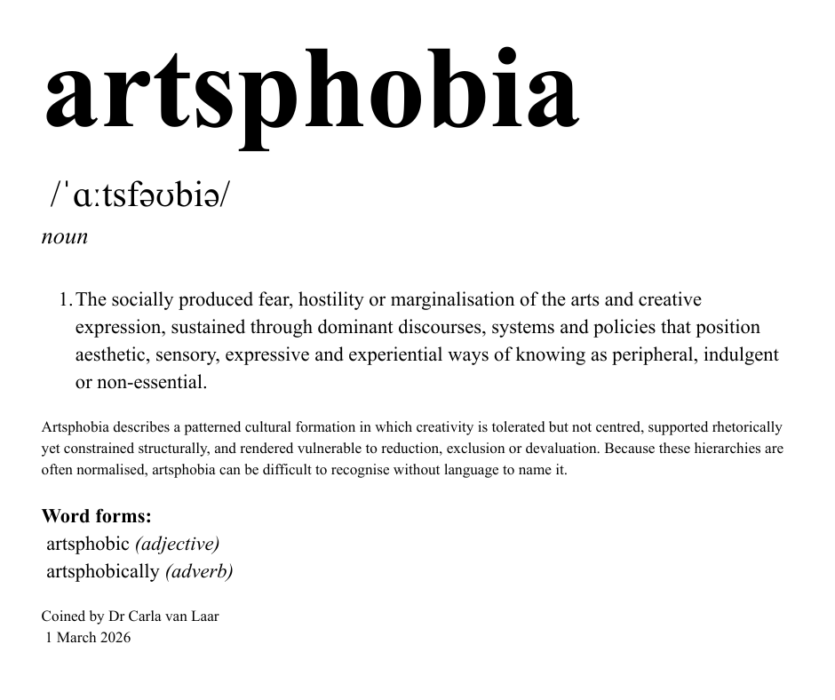
Artsphobia (noun)
The socially produced fear, hostility or marginalisation of the arts and creative expression, sustained through dominant discourses, systems and policies that position aesthetic, sensory and experiential ways of knowing as peripheral, indulgent or non-essential.
Artsphobia is the socially produced fear, hostility or marginalisation of the arts and creative expression. It operates through dominant discourses and policies that position aesthetic, sensory, expressive and experiential ways of knowing as peripheral, indulgent or non-essential — normalising their devaluation and rendering that marginalisation invisible or inevitable.
Artsphobia does not refer to a psychological anxiety disorder in the way claustrophobia does. Artsphobia is not a synonym for creative block or performance anxiety. Rather, it follows the broader social use of the “-phobia” suffix — where the term describes culturally embedded fear, aversion or systemic marginalisation directed toward a domain, practice or group.
Artsphobia names a pattern.
What Artsphobia Is
The term “Artsphobia” is an attempt to describe a recurring cultural formation in which creativity is tolerated but not centred, supported rhetorically but constrained structurally. In earlier public discussion, I referred to dogmatic cultural narratives that constrain or undermine imagination, diversity and/or equality. The concern here is rigidity wherever it appears.
Artsphobia names the hierarchy that covertly or overtly positions:
- measurable outputs over aesthetic contribution
- productivity over presence
- cognitive abstraction over sensory and experiential knowing
- economic return over cultural vitality
- clinical expertise over lived experience and community wellbeing
- cure over prevention.
How Artsphobia Operates
Artsphobia operates at multiple levels. Artsphobia is structural, not individual. It is a discursive practice that exerts power. As such, it manifests institutionally, and can also be internalised by individuals.
1. Discursive Artsphobia
Most significantly, Artsphobia operates through language (discourse, stories and cultural myths).
It appears when funding cuts to the arts are described as pragmatic rather than cultural losses.
When the precarious conditions of creative work are treated as inevitable.
When imagination is framed as optional.
When creative practice is considered a luxury in times of crisis — rather than infrastructure for resilience.
Because this devaluation is normalised, it often remains unseen.
2. Institutional Artsphobia
It appears as:
- Arts removed from curricula.
- Creative subjects framed as enrichment rather than core learning.
- Creative therapies positioned as adjunct rather than foundational.
- Evaluation frameworks that privilege quantifiable metrics while sidelining relational and presentational evidence.
3. Internalised Artsphobia: beliefs, self-talk, imposter syndrome
It appears as:
- “I’m not creative.”
- Shame about making.
- Fear of looking foolish.
- The internalised critic that stifles the impulse to create.
Naming Invisible Artsphobia
Artsphobia can be subtle. When certain epistemological hierarchies are repeatedly reinforced through language, systems, and policy, they begin to feel natural. Naming the pattern allows it to be examined.
Artsphobia works similarly.
Without language, individuals might assume:
“I’m just not creative.” Or, “The way I work is not good enough.” Or, “I am an imposter, I don’t know what I’m doing”. Or “I need to change myself to fit this system.”
Institutions can assume:
“This is just how budgets work.”
Policymakers may assume:
“The arts are secondary to essentials.”
Naming Artsphobia shifts the frame.
It allows us to ask:
- Who decides what is essential?
- What forms of knowing are being privileged?
- What cultural capacities are being quietly eroded?
When we can name Artsphobia, we can begin to identify artsphobic policies, artsphobic narratives and artsphobic funding structures.
When Is a Policy Artsphobic?
A policy may reasonably be described as artsphobic when it:
- Systematically reduces or excludes arts funding without recognising cultural impact
- Frames arts education as optional enrichment rather than core learning
- Excludes creative practice from definitions of health and wellbeing
- Treats artists as economically dispensable
- Privileges productivity metrics that fail to account for aesthetic, relational and cultural contribution
Disagreement about art is natural. What Artsphobia points to is something more patterned — the consistent relegation of creative practice to the margins of systems that shape public life.
Artsphobia Is Not New — It Is Newly Named
The term Artsphobia is new. The phenomenon is not.
In my 2021 blog, “The Artist or The Critic”, I described how we are socialised into limited roles in relation to art — either judge or judged. That binary reflects a culturally dominant evaluative discourse that narrows creative participation and internalises shame.
In Seeing Her Stories, I developed the idea of “multi-layered seeing,” consciously disrupting culturally dominant ways of engaging with artworks and cultivating embodied, relational, contextualised presence.
In What’s Beneath Our Feet?, co-authored with Melissa McDevitt Weston, we explored layered cultural and ancestral realities that remain unseen when dominant frameworks fail to acknowledge cultural significance.
In Empowering Voices, we documented lived experiences that demonstrate how creative and experiential therapies restore agency where systems have narrowed it.
Across these works runs a consistent thread: the tension between expansive, arts-based and experiential ways of knowing, and systems that marginalise or flatten them.
Artsphobia names that tension.
An Invitation to Notice and Name Artsphobia
Artsphobia is offered as a way of noticing — a way of paying attention to patterns that are often normalised.
It invites us to examine:
- Where have we internalised creative shame?
- Where are the arts being structurally sidelined?
- Where is imagination treated as indulgence rather than necessity?
- What would change if we recognised creative practice as human infrastructure?
If we are serious about health, education, community wellbeing and cultural sustainability, then aesthetic, sensory and experiential ways of knowing need to be recognised as central rather than peripheral.
The arts are integral to how individuals, communities and societies make meaning, process life and imagine futures. They are foundational to how we metabolise grief, build identity, cultivate empathy, form relationships and experience belonging.
I offer this term as an invitation to look more closely at the stories we tell about creativity — and at the systems that shape those stories.
…
Author’s note: If you reference or use this term in your work, please attribute it to Dr Carla van Laar (1 March 2026).
Citation:
van Laar, C. (2026). Artsphobia: The socially produced marginalisation of the arts. Introduced 1 March 2026. Available at: https://carlavanlaar.com/artsphobia/
Dr Carla van Laar is an independent artist, author, researcher, supervisor, and Creative and Experiential Therapist living and working on Boon Wurrung Country, in Inverloch, Australia. Her work bridges creative mental health, arts and health, and experiential therapies, positioning creativity as a vital public-health approach supporting wellbeing across individuals, communities, and systems.
For all inquiries please contact carla@carlavanlaar.com
Leave a Reply