
This article introduces the arts-based practice Neo-sensorialism – creative practice generated in sensory relationship with the living world.
Dr Carla van Laar
15 March 2026
Neo-sensorialism: Creative practice generated in sensory relationship with the living world
Neo-sensorialism (noun)
Definition: The arts-based practice of engaging the senses as primary modes of witnessing, being in relationship with the world, and creatively responding to experience in the present moment.
The term Neo-sensorialism was introduced by Dr Carla van Laar (2026) to describe creative practices that cultivate sensory awareness, relational engagement and creative response as integrated ways of knowing.
Rather than treating perception as detached observation, Neo-sensorialism recognises sensing as a participatory encounter through which people experience, relate and respond creatively within the living world.
A practice that begins in sensing
The concept of Neo-sensorialism emerges from lived creative practice.
During my doctoral research project Seeing Her Stories, I described the experience of painting in situ asan immersive sensory encounter with environment:
“As I hold the brush and urge the paint onto the canvas, a satisfying connection occurs through my hand and arm as I feel the resistance of the surface and push into it with my brush and the slippery fluid medium.
I continue drinking in the scene before me with my whole body, responding to my environment and the marks I am creating before me, through the movement of my muscles, thoughts and sensations.
This is a very soothing activity… My attention is focused in the here and now, with awareness of my surroundings, my place within them; my embodied relationship with all that I am seeing, hearing, smelling, feeling, touching and moving.
The resulting artworks visually tell my stories of seeing.”
— Seeing Her Stories, Chapter 5 (2020)
This description captures several core aspects of Neo-sensorialist practice:
- sensory immersion
- embodied response
- relationship with environment
- artwork as trace of encounter
In this way, creative practice does not begin with an idea to be executed, but with attention to sensory relationship with the world.
From this relationship, gestures emerge, marks are made, and artworks gradually take form.
The moment the term appeared
Although the orientation had been present in my creative practice for many years, the word Neo-sensorialism first surfaced publicly during a doctoral presentation in 2018.
Following the presentation, a lecturer from the University of Melbourne asked me a simple question:
“Do you have a word to describe your painting style?”
Until that moment, no one had asked me this directly.
Somewhat shyly, I replied:
“Yes… I imagine it as Neo-sensorialism.”
The term emerged not as a deliberate act of naming a movement, but as a way of describing a practice that had already been developing through lived artistic and research experience.
Sharing the practice
Elements of this sensory-relational approach had already been shared widely within the Australian creative arts therapy community.
In 2013, during the ANZATA conference at Western Sydney University, I facilitated a workshop inviting colleagues to experiment with a process I described as drawing from the senses.
Participants were encouraged to suspend pre-planned imagery and instead respond to sensory experience as it unfolded — allowing marks, gestures and forms to emerge from embodied awareness.
Later, when contributing to the development of the IKON Institute Bachelor of Arts Psychotherapy degree around 2015, this practice became embedded within course curriculum as a way of cultivating sensory awareness and creative responsiveness in therapeutic practice.
I have also facilitated this practice as part of professional development workshops exploring the notion of “coming to our senses” (20219), painting outdoors during therapeutic group workshops with war veterans (2024), painting from still life in community based art workshops (2024) and with practitioners at the Creative Mental Health Forum (2025), and over the years I have painted together with many peers and colleagues in various in situ settings, where I introduced them to this practice.
Through these forms of sharing — workshops, teaching and collaborative practice — the approach has circulated widely among creative practitioners, often adopted and adapted in practice, even when it has not been explicitly named.
Naming Neo-sensorialism now simply offers a way to recognise and articulate a mode of creative practice that many artists and therapists already intuitively engage.
Lineages and related movements
Neo-sensorialism sits within a long lineage of artistic and philosophical traditions that recognise the importance of sensory engagement with the world.
The oldest and most enduring of these are the knowledge systems of Indigenous cultures, which understand humans as embedded within complex relational systems connecting people, land, community and the more-than-human world. These knowledge systems continue to offer profound guidance about the relational nature of perception, place and creative expression.
In various philosophical and artistic traditions, related ideas can be found within:
- Phenomenology, particularly the work of Maurice Merleau-Ponty, who explored perception as embodied experience within the world
• Impressionism, which investigated how light and atmosphere shape visual perception
• Expressionism, which emphasised emotional and gestural response
• contemporary relational and ecological art practices
Where Impressionism focused on visual impressions of light and atmosphere, Neo-sensorialism emerges from immersive sensory relationship with the living world.
In Neo-sensorialist practice, the artwork is not considered to be merely a representation of what was seen, but a trace of the encounter itself, carrying forward the energy of that sensory relationship. The resulting artwork is at once a trace of the encounter, an empirical object of evidence, and an energetic active agent that continues to exert effects on those who engage with it.
Artworks as traces and agents
A distinctive aspect of Neo-sensorialism is the recognition that artworks function in layered ways simultaneously.
They are:
traces of encounter
The marks, gestures and forms within the artwork carry evidence of the sensory relationship through which they were created. In this way, artworks can be thought of as ‘empirical evidence‘.
And they are also:
active agents
Once created, the artwork continues to participate in relational experience — influencing perception, emotion and reflection in those who encounter it.
In this way, the artwork does not merely represent experience; it extends the encounter into new relationships.
What Neo-sensorialism is not
Neo-sensorialism is not a stylistic movement defined by a particular visual appearance.
Nor is it confined to painting.
Musicians, dancers, writers and other artists may all work in Neo-sensorialist ways when creative practice emerges from sensory immersion and relational response.
What defines the approach is not the medium, but the orientation to sensing, relating and creating.
Neo-sensorialism within a creative worldview
Neo-sensorialism can be understood as the practice dimension of a broader creative worldview.
In earlier articles I introduced two related concepts:
Artsphobia
The culturally conditioned fear of the arts.
Creative-worldview
An orientation that recognises creativity as a fundamental human capacity through which people sense, relate and create meaning in the world.
Within this framework:
Artsphobia names the problem.
Creative-worldview names the orientation.
Neo-sensorialism describes the practice.
Together these ideas point toward the possibility of creative practices that reconnect people with sensory awareness, relational presence and imaginative participation within the living world.
Neo-sensorialism can be understood as the practice dimension of a broader creative worldview.
A neo-sensorialist invitation
Neo-sensorialism invites renewed attention to the role of the senses in human knowing.
In a time when much of contemporary life pulls attention toward abstraction, screens and disembodied forms of communication, practices that reconnect people with sensory awareness offer a way of returning to presence — to the felt experience of being alive within the living world.
Creative practice then becomes not simply a means of producing artefacts, but a way of participating in relationship with environment, where sensing, movement and imagination unfold together.
Within this orientation, artworks are more than representations of experience. They are traces of sensory encounter, and they continue to exert influence through the relationships they generate with those who later encounter them.
Neo-sensorialism names one such approach: creative practice generated in sensory relationship with the living world.
Together with the concepts Artsphobia and Creative-worldview, Neo-sensorialism forms part of a broader effort to articulate the cultural importance of creative practice.
Where Artsphobia names the cultural fear that marginalises the arts, and Creative-worldview describes an orientation that recognises creativity as a fundamental human capacity, Neo-sensorialism describes a way of practising creativity through sensory relationship with the world.
Reference
van Laar, C. (2026). Neo-sensorialism: Creative practice generated in sensory relationship with the living world.
The term Neo-sensorialism was introduced by Dr Carla van Laar to describe creative practices that are generated through sensory immersion, and embodied creative responses to being in relationship with, and part of, the living world. The concept draws on doctoral research presented in Seeing Her Stories (van Laar, 2020).
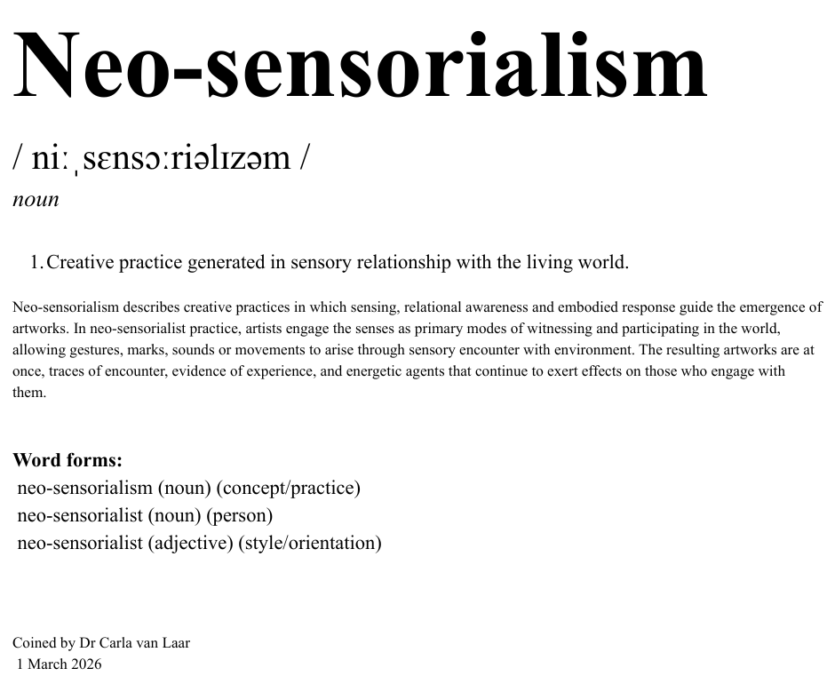
Neo-sensorialism
/ niːˌsɛnsɔːriəlɪzəm /
noun
- Creative practice generated in sensory relationship with the living world.
Neo-sensorialism describes creative practices in which sensing, relational awareness and embodied response guide the emergence of artworks. In neo-sensorialist practice, artists engage the senses as primary modes of witnessing and participating in the world, allowing gestures, marks, sounds or movements to arise through sensory encounter with environment. The resulting artworks function both as traces of these encounters and as active agents that continue to influence those who later engage with them.
Word forms:
neo-sensorialism (noun)
neo-sensorialist (noun)
neo-sensorialist (adjective)
Coined by Dr Carla van Laar
2026

Dr Carla van Laar is an independent artist, author, researcher, supervisor, and Creative and Experiential Therapist living and working on Boon Wurrung Country, in Inverloch, Australia. Her work bridges creative mental health, arts and health, and experiential therapies, positioning creativity as a vital public-health approach supporting wellbeing across individuals, communities, and systems. Creative-worldview underpins Dr Carla’s practice ecosystem through her offerings of Creative Flow Open Studio, Supervision Studio, Inverloch Creative Therapies, and Creative Mental Health Events.
For all inquiries please contact carla@carlavanlaar.com
Leave a Reply