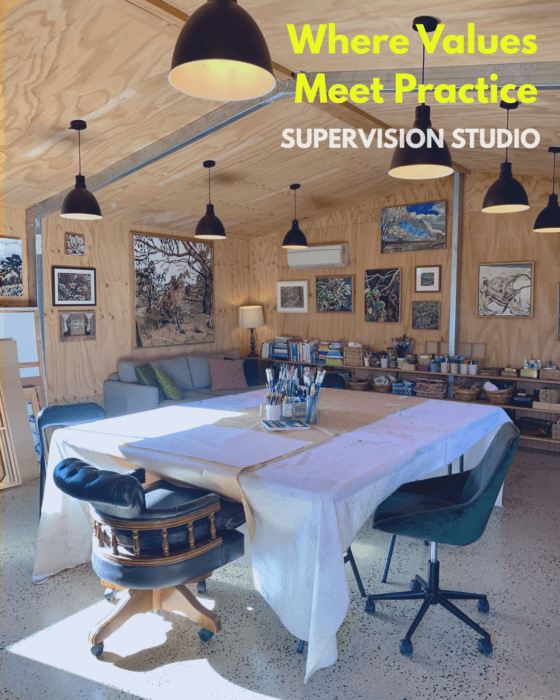
Where Values Meet Practice – Inside the Supervision Studio
The calling and the dissonance
People who choose the helping professions often describe feeling a “calling”, and experience their work itself as an art.
We can be particularly empathetic, sensitive and attuned to subtleties of the human condition.
There can be a particular quality of our attentiveness to emotion, story, relationship and meaning. Over time, maintaining this attentiveness can become both a resource and a responsibility. Many of us learn to hold complexity and uncertainty in support of others. We learn to pay careful attention, to respond in the moment, to be flexible, adapt. We finely tune ourselves as an instrument to use in the service of others.
However, all too frequently, the environments we work within do not always speak the same relational, creative language as the work itself.
Sometimes, our practice can be diluted incrementally as it is translated into language originating in other professions or contexts: plans, notes, categories, goals, and measurable outcomes. These seemingly necessary tasks might be carried out conscientiously yet accompanied by a niggling sense of dissonance from the living process of our roles caring for others and the reasons we were originally called to it.
Among other things, the Supervision Studio can become a space where this dissonance can be noticed and re-aligned, restoring congruence, healing moral wounds, and returning us to the practices we know and value so deeply – back to the heart of our work.
A space where nothing is required, and something can emerge

Holding our work with care
The Supervision Studio has run consistently since 2019, moving online in 2020, and brings together creative and experiential therapists, counsellors, psychotherapists, social workers and spiritual care practitioners from across Australia. Our practices center trauma-sensitive, bottom-up, creative approaches, and art as a way of knowing. In the Supervision Studio, we connect or reconnect with these practices, and with the parts of ourselves that get lost, ignored or even hurt by the sometimes-harsh contexts that we work within.
The network of people who access the Supervision Studio is diverse, and people gather in the space from all over Australia. It runs very regularly, once every two weeks, and each group is capped at six participants. Members are free to join as frequently as they need to, with no pressure. The Studio remains a steady presence and will be there when it is needed. Over time, it becomes familiar — not because the content of sessions repeat, but because intention is held in a consistent way.
I facilitate with a sense of reverence for the work practitioners carry. My role is to hold with care, providing a container for connection and creative process, tracking safety, regulating pace, and supporting meaning to form without being rushed.
Sessions begin with a shared and guided experiential arrival. From there, I offer creative processes for participants to follow threads connected to their work. I always ensure there is plenty of time for individual art making, as this is a form of inquiry, and I want to ensure each member has time to connect with their own creative flow. We share as a group, and there are opportunities for witnessing, being seen, and both giving and receiving creative responses.
Insights and understandings develop relationally, through allowing what is present to surface, take form, and be shared.
Our time together begins in the moment of arriving, becoming present.
Walking our talk
Using the tools of our own trade in the Supervision Studio enables our own complex and challenging issues to be seen and explored. For example, some practitioners arrive in the Supervision Studio after years of adapting their language to fit professional systems. They may have been supervised within other disciplines, or work as the sole practitioner of their approach inside multidisciplinary teams.
It becomes a challenge to find ways of remaining professionally responsible while still practising congruently.
Sometimes this involves re-claiming the language used in documentation so it accurately reflects responsive therapeutic practice rather than predetermined steps. When practitioners can describe their work in ways that meet organisational requirements while preserving its integrity, discomfort settles, resonance and congruence return. The task no longer feels like a compromise – or a moral wound – each time it is completed.
Moments like this restore continuity between a practitioner’s values and their daily actions. For many of us, this kind of congruence is absolutely essential for our own wellbeing. Without it, we are stressed at a deep, existential level, and cannot continue our work. All too often, this experience goes hand in hand with what is commonly known as ‘burn out’, or internalised as “imposter syndrome”. At times, the feeling often described as imposter syndrome may be a signal that our way of working doesn’t quite fit the paradigm we are being asked to operate within. It’s not necessarily simply about the burden of our workload, but also about the moral distress caused by the impact of enacting practices that are an assault to our core professional, helping values.
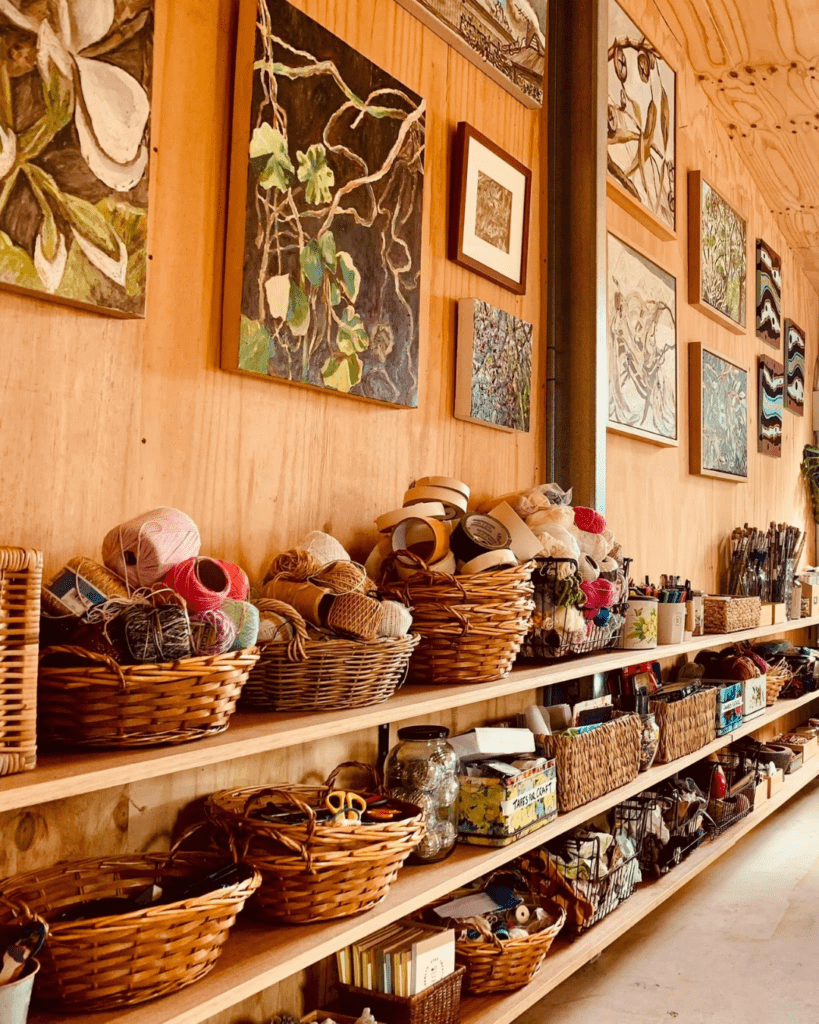
Knowing sometimes starts in the hands and what they reach for
Knowing through creative experiencing
In the Supervision Studio, reflection unfolds through attunement and the creation of a shared relational field, through art-making, image, gesture, embodiment, intention, poetry, and story. Words arrive alongside experience and deepen understanding.
The group plays an essential role. Practitioners recognise themselves in each other’s material, and shared practice wisdom forms across disciplines and career stages.
We come to our senses, stay with the art, listen to our heart
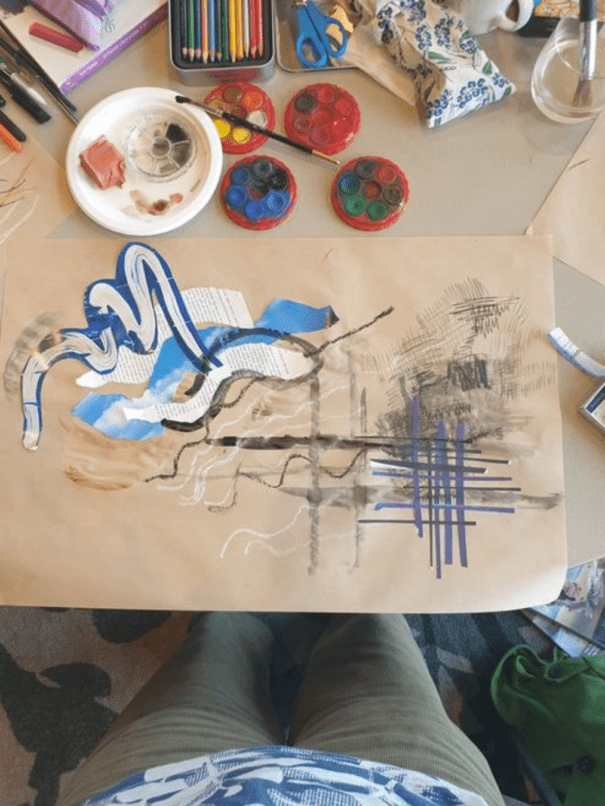
Returning to centre
The Supervision Studio runs fortnightly in small groups (maximum six participants) and is PACFA-recognised supervision.
Over time, Supervision Studio becomes a place practitioners return to that helps them to remain connected to their professional centre and their community of support — a place where their work can be felt, expressed, explored, processed, shared and integrated, and a place where helping professionals themselves can receive care, can be held and nurtured, before they return to accompanying others.
Support that steadies without directing.

The Supervision Studio is a small fortnightly online group where reflective practice unfolds through shared process and intention.
Practitioners join from across Australia and over time the group becomes a dependable place to return — a space where professional experience can be integrated before continuing to accompany others.
If this resonates with how you like to reflect on your work, you are welcome to join.
Perspective keeps expanding after the session ends
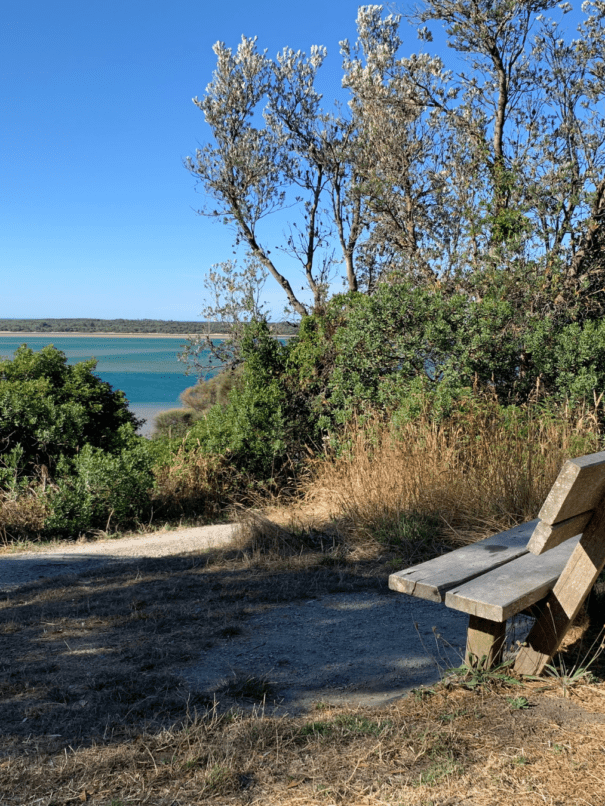
New members are always welcome.
If you would like to join us, please reach out to me via email: carla@carlavanlaar.com
Returning to practice with a slightly different orientation
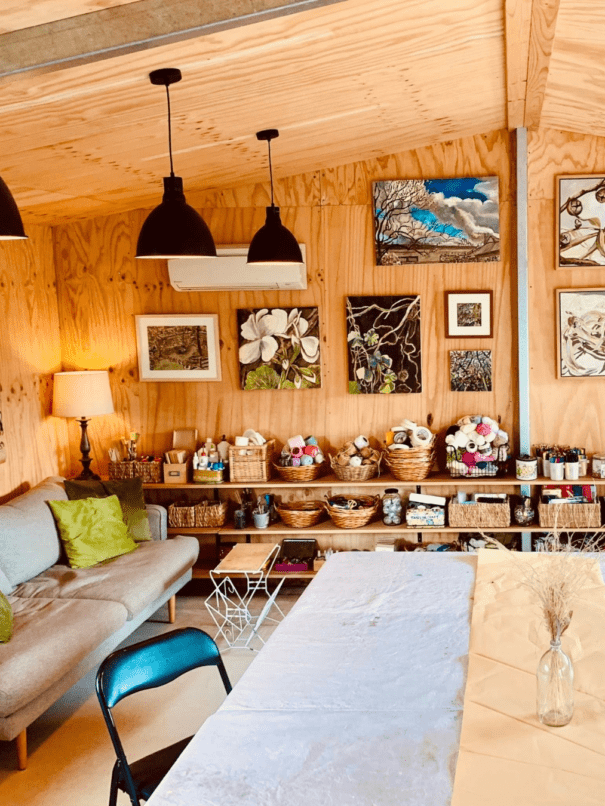
Dr Carla van Laar is an independent artist, author, researcher, supervisor, and Creative and Experiential Therapist living and working on Boon Wurrung Country, in Inverloch, Australia. Her work bridges creative mental health, arts and health, and experiential therapies, positioning creativity as a vital public-health approach supporting wellbeing across individuals, communities, and systems.
For all inquiries please contact carla@carlavanlaar.com
2 Comments
Deborah Green
Thank you. Love your work, Carla.
Carla
Thanks Deborah, lovely to know it connected with you. In solidarity, Carla.